
Clicker Games | Play Free Online Games
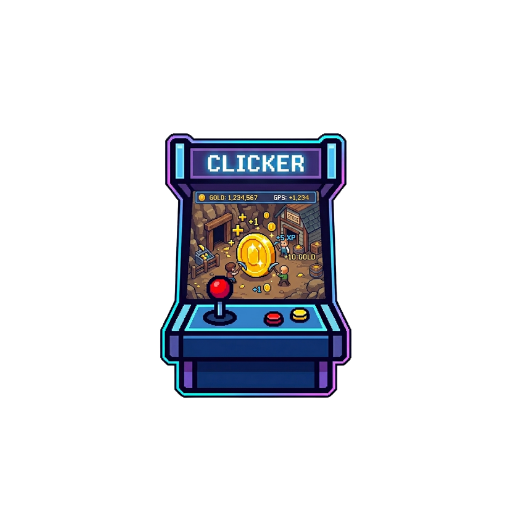
Clicker Games: The Simplest Addiction in Gaming
One click. That's all it takes. A single tap on a cookie, a button, an icon — and something in your brain lights up. A number goes up. A small reward appears. And before you fully understand what has happened, you are clicking again. And again. And again. Not because you have to. Not because a story demands it or a boss is waiting. Simply because the number going up feels genuinely, inexplicably good.
Clicker games are one of gaming's most fascinating phenomena — deceptively simple on the surface, deeply engineered underneath, and more addictive than almost anything else the medium has produced. At WikiGames.io, the Clicker Games tag is your complete guide to the genre that turned the most basic interaction in computing into an art form — from the humble origins of the idle game to the staggeringly complex incremental systems redefining what clicking can mean.
What Are Clicker Games?
Clicker games — also known as idle games or incremental games — are games built around the repeated performance of a simple action, typically clicking or tapping, to generate a resource that is then reinvested into systems that automate and amplify that resource generation over time. The gameplay loop is extraordinarily simple to understand and extraordinarily difficult to put down.
At their most basic, clicker games ask you to click to earn. Earn enough, and you can buy upgrades that click for you. Buy enough upgrades, and the numbers begin to grow exponentially. Come back an hour later and discover that the game has been playing itself while you were away — and that the numbers are now almost incomprehensibly large. That discovery, that moment of returning to find your empire has grown without you, is one of the most uniquely satisfying feelings in all of gaming.
The design pillars that make clicker games so compulsively engaging:
- Instant gratification — every click produces an immediate, visible reward with zero friction or delay
- Exponential progression — numbers grow at rates that create a genuine sense of snowballing momentum
- Idle mechanics — the game continues to reward you even when you are not actively playing
- Prestige systems — resetting progress for permanent multipliers, creating a satisfying long-term meta loop
- Upgrade trees of surprising depth — beneath the simple surface lies a web of strategic decisions about resource allocation and timing
Clicker games are also among the most accessible titles in all of gaming. No prior experience required, no controller complexity, no failure states. Just a screen, a pointer, and the endlessly satisfying feedback loop of numbers going up.
From Cookie Clicker to a Genre
The clicker game genre as a recognized category has a surprisingly precise origin point. Cookie Clicker, released by Julien Thiennot in 2013, crystallized the formula so perfectly and presented it with such self-aware wit that it essentially created the genre overnight. Players clicked a giant cookie to bake more cookies, spent cookies on grandmas and factories and portals to cookie dimensions, and found themselves several hours later questioning their life choices in the best possible way.
But the seeds had been planted earlier. Progress Quest — released in 2002 — satirized RPG progression by automating it entirely, creating a game that played itself and invited players to simply watch numbers climb. Cow Clicker deconstructed social gaming mechanics with pointed irony. Candy Box introduced genuine RPG elements into the clicker framework and expanded what the genre could contain.
After Cookie Clicker, the space exploded. Clicker Heroes brought character progression and combat into the formula. Adventure Capitalist framed exponential growth as a capitalist satire. Realm Grinder added faction systems and strategic depth that rivaled traditional RPGs. Antimatter Dimensions pushed the mathematical complexity of incremental progression to its absolute limits. Melvor Idle translated the entire RuneScape skill system into idle game form. Each title proved that there was no ceiling on what the genre could absorb and reinvent.
Why Clicker Games Are More Than They Appear
The casual dismissal of clicker games — the suggestion that clicking a cookie is not real gaming — misses something important about what these games actually do. Clicker games are, at their core, systems games. They reward players who understand exponential growth, who recognize optimal reinvestment timing, who can read an upgrade tree and identify the path of maximum efficiency. The strategic layer is real, even if it is wrapped in the most approachable interface imaginable.
They are also one of gaming's most honest experiments in behavioral psychology. The designers of clicker games understand reward loops, variable reinforcement schedules, and the neuroscience of progress in ways that inform how they build their systems. Playing a well-designed clicker game is, in a very real sense, watching those principles operate in their purest form.
The genre has also proven to be one of the most creatively elastic in gaming. Clicker mechanics have been fused with tower defense, with narrative fiction, with horror, with management simulation, and with deep RPG systems — demonstrating that the incremental loop is a foundation capable of supporting almost any type of game built on top of it.
What You'll Find in the Clicker Games Tag on WikiGames.io
Game Guides & Progression Walkthroughs
Complete coverage of the genre's biggest titles, with optimal upgrade paths, prestige timing guides, and strategies for pushing past progression walls as efficiently as possible.
Idle Game Recommendations by Depth
From five-minute casual experiences to games that will occupy your browser tab for months, our curated lists match every type of player to the clicker experience that fits them best.
Mechanics Breakdowns & Strategy Guides
Deep dives into the systems that power the genre's most complex titles — prestige layers, offline progression formulas, and the mathematical principles behind exponential growth curves.
Hidden Gems & Browser Classics
The clicker genre has a rich history of extraordinary browser-based titles that deserve rediscovery. We document them, celebrate them, and make sure they find the audiences they deserve.
New Releases & Genre Evolution
The incremental game space moves fast. Our coverage tracks new releases, genre-pushing experiments, and the developers expanding what clicker games can be.
Start Clicking at WikiGames.io
You came for the click. You stayed for the prestige reset. You came back for the offline earnings. You are, whether you realized it or not, exactly the kind of player the Clicker Games tag at WikiGames.io was built for. Browse our full collection of clicker and idle game coverage — guides, recommendations, deep dives, and discoveries — and find your next beautiful, unstoppable number-going-up obsession.
One click is all it takes. You know what to do.